MATHIESON
Can you describe your relationship with the masters and artisans of Jingdezhen? What have you learned from them that cannot be taught in a design school?
JIALUN
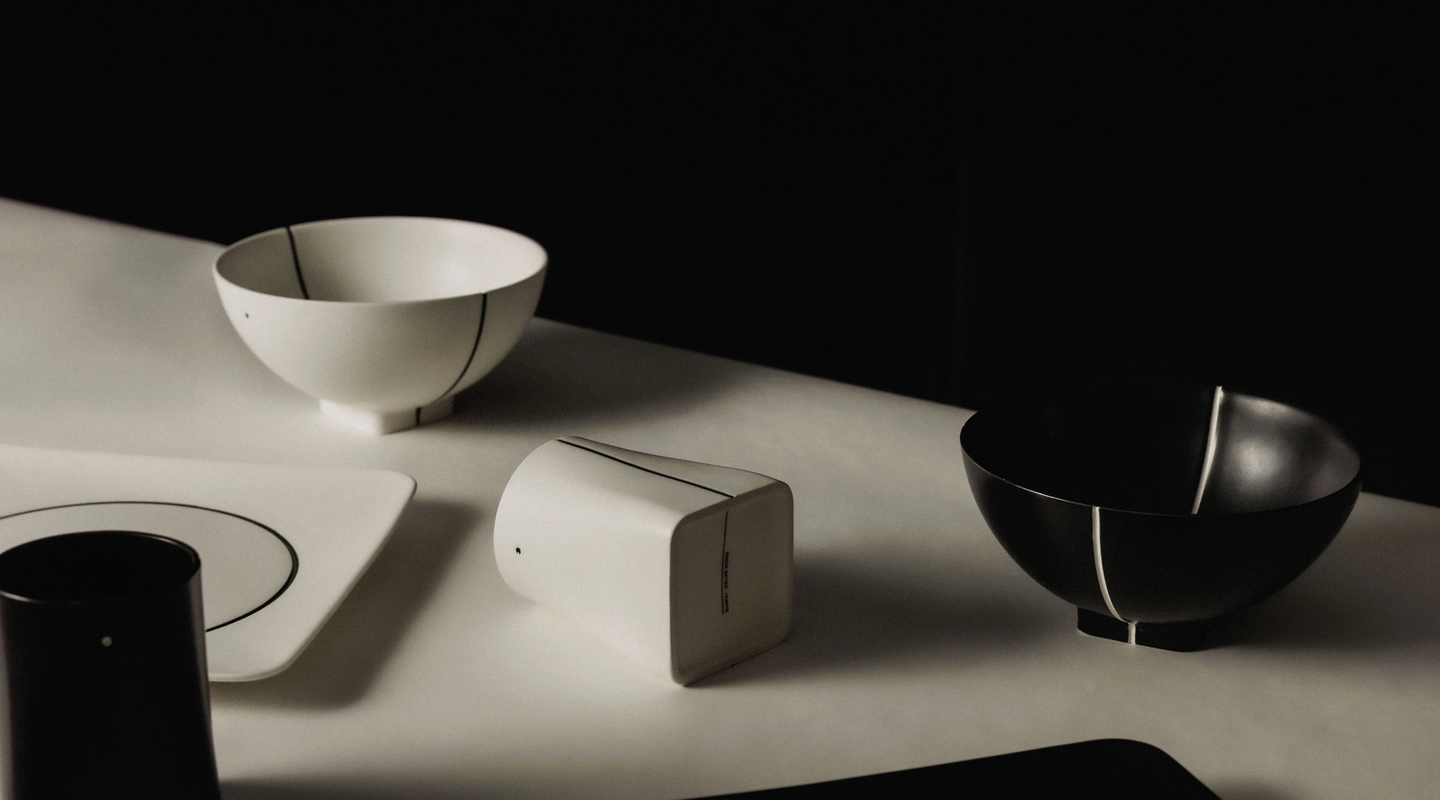
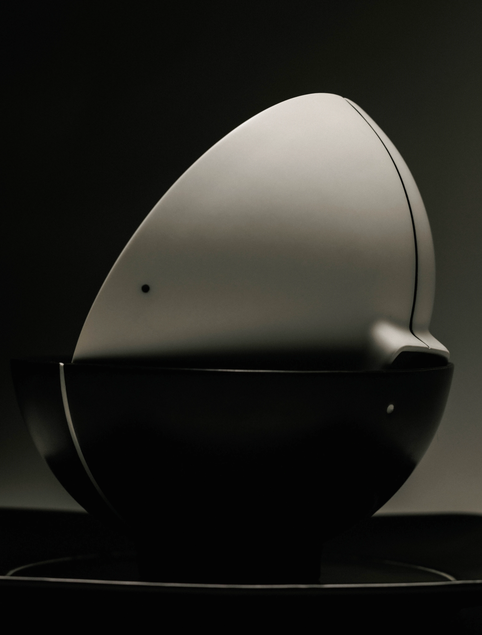
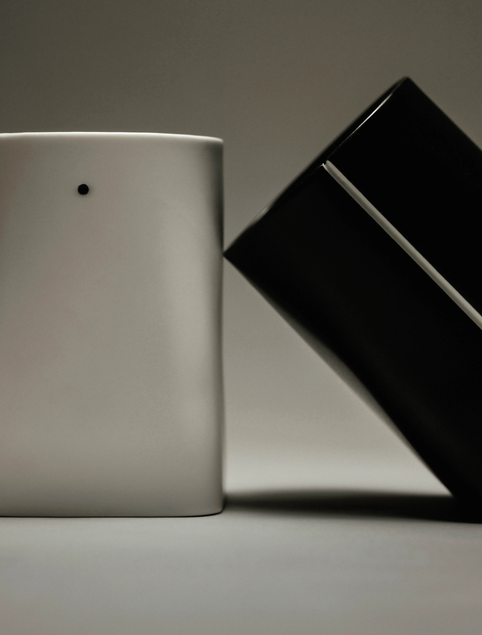
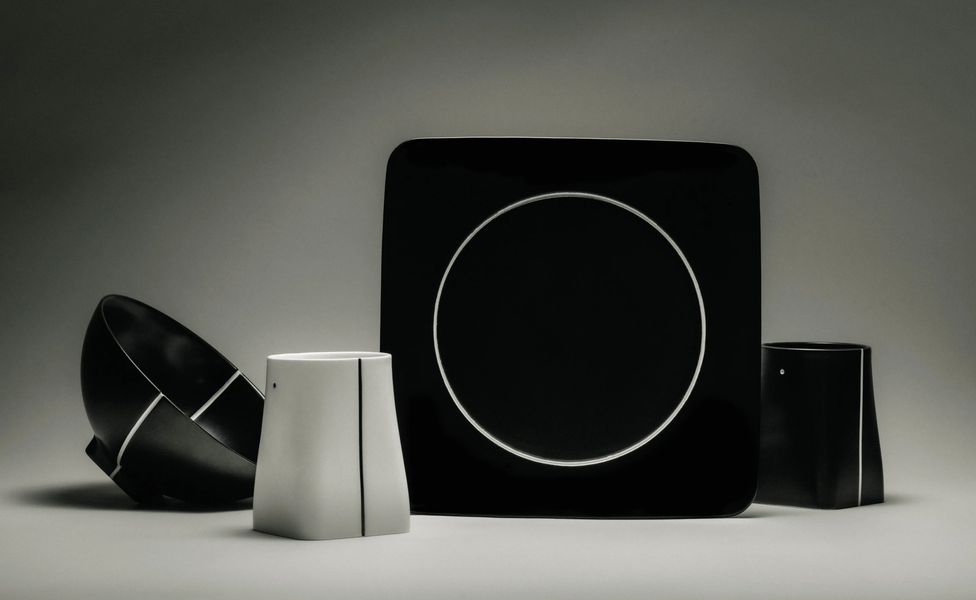
My relationship with the artisans in Jingdezhen is built on observation and mutual respect rather than instruction. It is a dialogue between precision and intuition. In the Symmetry Collection, extreme control is sometimes demanded by the accuracy of dots and lines, or the transition between a circular top and a square base. I knew from the beginning that these geometric tensions would challenge the material.
Jingdezhen carries over a thousand years of porcelain history. What I learned goes beyond technique. I learned patience, material sensitivity, and humility. Clay has memory. At every stage - throwing, trimming, drying, glazing and firing, it can shift, shrink, resist, or surprise you. So the batch production in Jingdezhen by artisian's hands allowed me to learn how to negotiate with the material. Each piece becomes a quiet collaboration. I aim for precision, but I respect unpredictability. These nuances cannot be taught through critique or theory. They are absorbed through repetition and presence.
MATHIESON
Porcelain is often associated with delicacy and ceremony. Do you think about how your objects are held, used and lived with in daily rituals?
JIALUN
Yes, I think about that often.
Porcelain is commonly associated with delicacy and ceremony, yet it has long been used in architectural contexts that demand durability and longevity. It is far more resilient than people assume. That duality - visual lightness with structural strength - interests me deeply.
When I design, I consider how a piece is held, balanced, and lived with over time. The weight in the hand, the thickness of an edge, the stability of in use - these details shape daily experience.
I’m less interested in porcelain as something precious, and more interested in it as something enduring. The goal is a quiet refinement that supports ritual without exaggerating it.
MATHIESON
In a world of rapid production, you continue to work through processes that are slow and exacting. What does time mean in your studio?
JIALUN
Time is a material in my studio.
In a culture of acceleration, I’m more interested in compression - refining an idea until it feels inevitable. Slowness, for me, is not about nostalgia. It is about precision.
Porcelain demands patience. Every stage requires intervals that cannot be rushed without consequence. The material sets its own tempo.
Working this way allows space for iteration and subtraction. Many decisions are removed rather than added. What remains is often minimal, but that clarity is the result of time. Time, in my practice, creates depth. It allows proportion to settle and intention to become quiet but firm.
MATHIESON
Material purity seems central to your philosophy. Are there materials you are curious to explore beyond kaolin, or does constraint create the depth you seek?
JIALUN
Constraint creates depth.
Kaolin does not feel limiting to me. Within its density, there are endless variations of thickness, translucency, surface tension, and light. Material purity allows me to focus on proportion and form without distraction.
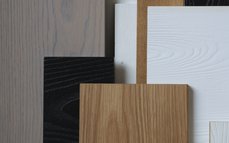
That said, my broader practice includes metal, wood, stone, glass, and textiles in furniture and lighting. Each material carries a different emotional weight and structural logic. Together, they embody tensions I am constantly exploring the strength and fragility, weighty or weightiness, control and unpredictability.
Constraint, for me, is not restriction. It is concentration.